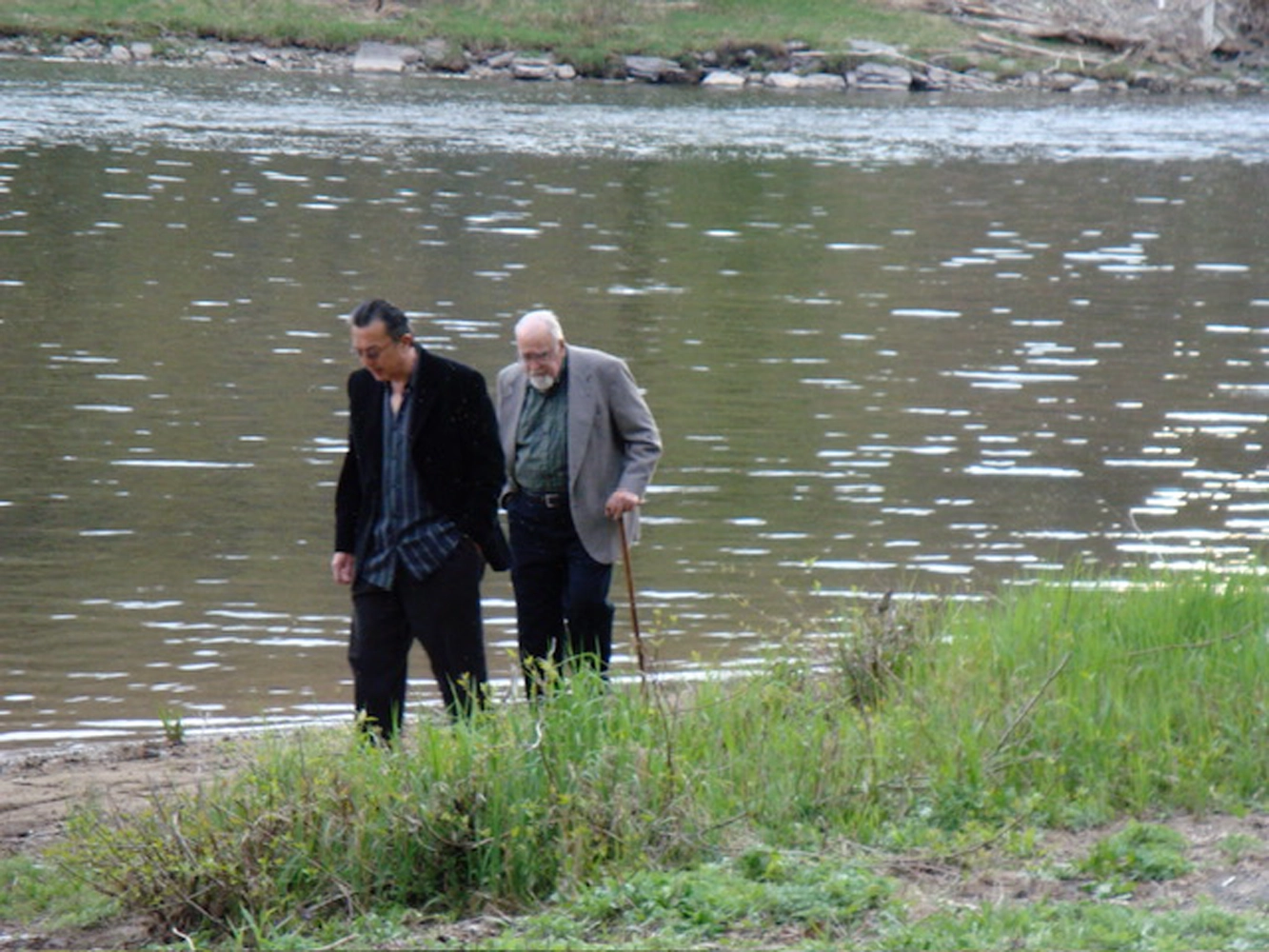
After I settled Dad into Bethany Senior Living, I cleaned his apartment. His once cheerful place overlooking the Delaware River in Callicoon had turned sour with everyday trash, old laundry, and broken appliances squatting in cabinets, under his bed, behind his couch—all gathering a crusty patina of stickiness. I had salvaged his collections of ceramic turtles, buffalo nickels, Red Sox souvenirs, and favored books to make his new room a home. I tried to delude myself that this was a home, not the way station to keep him reasonably tidy and comfortable until he died—a way of killing time.
***
I should have seen Alzheimer’s coming. One morning after fly fishing in a no-kill stretch of the Beaverkill, we took a cooling dip during which, in mid-stroke, Dad “forgot” how to swim. Fortunately, we were in water only waist high. When we drove on local roads, he wondered aloud where we were. Forgetting how to turn off the TV, he’d disconnect the cables and power cord. Eventually the disease barged into his life like a terrible drunk. One night at Bethany he woke up panicked, barricaded his door with whatever furniture he was strong enough to move. He insisted he had been kidnapped. Thanks to the miracle of chemistry, the kidnappings stopped.
***
I’d take him out for Chinese or Italian. I feared an egg roll or sausage could be a noose for this toothless man. If he choked, I’d be poised to apply the Heimlich maneuver. Yet … a coarse, repulsive alternative would blink its knowing eye at me. You see? I could let him die.
In his addled frame, my father can’t remember that his mother asked him for help in committing suicide. Grandma made that appeal to him, some 25 years ago, when she was in a nursing home.
My father had told me, “Grandma wanted me to end her misery. So, I said, ‘Mom, first of all, how would I get drugs like that?’ She said, ‘Well, you work in New York City. You know people. It can’t be that hard.’ Can you imagine?”
***
He was further dumbstruck, when in that same conversation, she casually mentioned an abortion she had in the 1930s. I was stunned that my grandmother chose to confess this to her eldest son. Either out of her mind and or too much within it, she had outlived her abiding sense of propriety, taking one less secret to her grave. Dad recounted Grandma’s confessions to me before the pests of his slipping awareness swelled into pestilence. I offered anthropological factoids for comic relief.
“You know, Dad, I’ve read that some primitive cultures deal more efficiently with the old and infirm. For example, abandonment alongside the trail, premature burial, cannibalism, and a peculiar example, a savage beating by assigned relatives, often a son-in-law.” You see, things could always be worse.
***
When I emptied Dad’s desk in Callicoon, I found notes and material about suicide carelessly mingled with shopping coupons and empty candy wrappers. The morbid archive included an address for ordering a book, Final Exit—Let Me Die Now; a euthanasia newsletter from the Hemlock Society, and recipes for suicide cocktails that called for Seconal, Nembutal, booze and, for good measure, a plastic bag for self-suffocation. He had plastic bags around his apartment but lacked the other requisite paraphernalia.
As an idea, death in one fell swoop seemed infinitely preferable to dying one brain cell at a time. But when faced with the reality, you see, I could not facilitate my father’s suicide, no more than he could respond to his mother’s call for help. Now, Dad forgets suicide ever crossed his mind.
We laugh. Our derisive banter resonates with a lifetime of jabs and insults. Starting in jest, these episodes could spiral downward. In my late teens and early twenties, we carved a rowdy path from bars on the West Side to Harlem to Newark, father-son bonding fueled by alcohol and, at once, weakened by it. For me, that toxic togetherness was a way to catch up for lost time. But you see, we were only killing time. We had unfinished business and it stayed that way.
Without memory, what will tell us that, in order to understand love, you must peel back memory’s skin, even where it hurts? To understand, you must remember and fight for every inch.
***
My story ends with a poem on this Father’s Day:
A Short Elegy for The Fisherman
When spring comes,
I’ll carry my Old Man’s ashes
down to the river at dusk,
when trout rise and dive
below the riffles between
their grand worlds of air and water.
When spring comes,
I’ll crouch at the riverbank and pour
The Fisherman back into
the song of water moving,
the promises of rainbows
jumping.