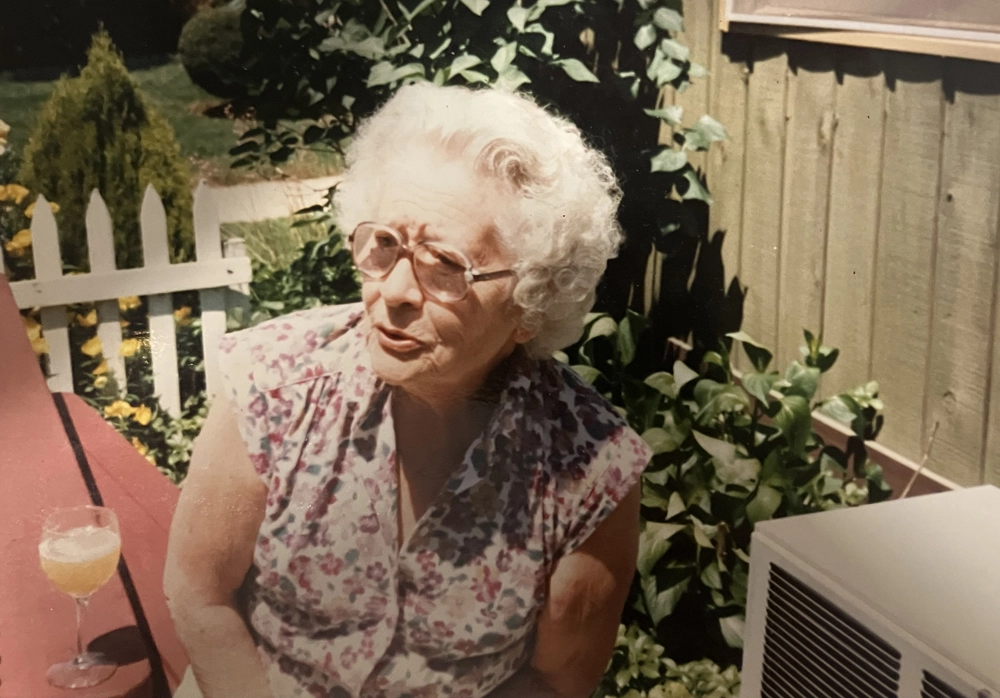
Soon after Mom deserted us Dad foisted me on my grandparents then sidled away as a part-time father. I was eight then and Grandma was fifty-eight. That half-century between us seemed as wide as a geologic epoch. The distance between us, her birth in Mechanicville, New York and mine in Yokohama, Japan was half a planet apart.
As I searched for my place, my kind, and myself, the Ancient Ones were steadfast and trustworthy. They would not flee into the night or spin into a rage like my mother. They would never drop out of sight for weeks at a time like Dad. Together, the Ancient Ones saved me, but it was Grandma who quietly did the heavy lifting.
She was born Ida Elizabeth Kipp in Mechanicville, New York in 1898. She survived the childhood deaths of brothers and sisters, the 1907 polio epidemic, the Great Depression, and two world wars. She was graduated from Wells College in 1922, which enabled her to leave the cold glare of a disapproving father and make her own way. She married William Fellenberg in 1928, with whom she raised three sons.
What If
I left for college as autumn’s unpredictable light
flashed among the sun-dappled leaves falling
from the ancient oak towering above our home.
I had packed books, writing tablets, a rabble of clothes
and vague hopes; stuffed them all in the same suitcase
Grandma took to college a half century past.
I sat in my rusty Ford, rolled down my window
and said: I guess I’ve got everything
Yes, Grandma said, I think you have everything,
her eyes sparkly, maybe as they were in 1917
when she hoisted that suitcase up to the last step
of the train car that clattered to the world beyond.
We had kept our family tales unspoken:
my mother’s tsunami of woes which swept her away;
my father who sank like a stone in her wake;
and when this boy thrashed in his waves of grief
how the Ancient One with silver hair, hazel eyes, (and the limp
that wasn’t there) reached in and plucked him out.
More than grandmother but never quite mother—
neither fish nor fowl she might say—a cliché always at hand.
We honored the family’s tacit vow to keep feelings caged
lest they break free and eat us alive
I remember ever this old woman under the ancient oak
shading her eyes from autumn’s unpredictable light.
What if I had broken our family spell and unleashed
a jubilation as loud as that locomotive churning
through the hills and valleys toward our mutual destiny?
What if I had held her and said at last,
Grandma, thank you for saving me,
for giving me the courage to say I love you.